
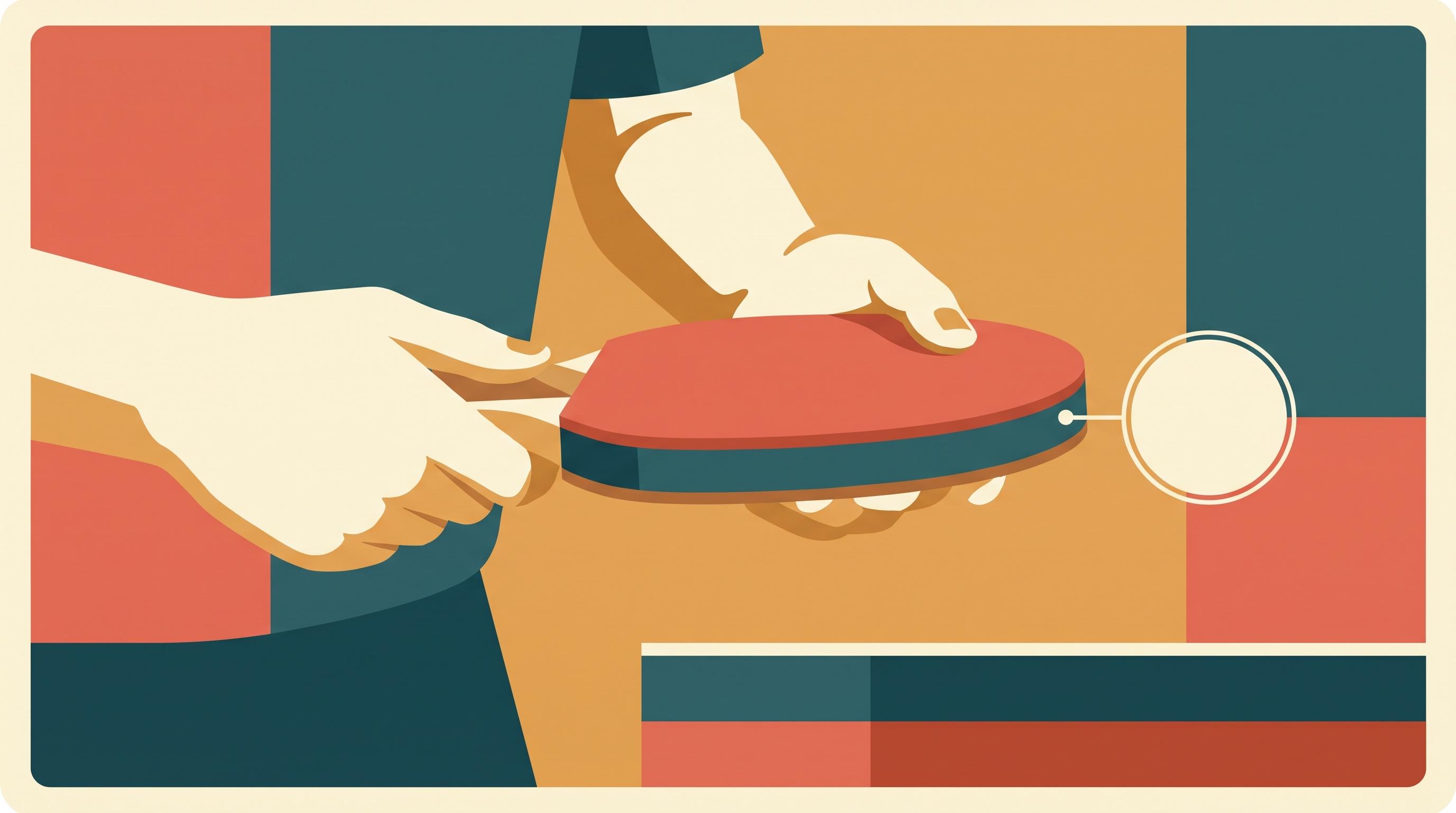
Table Tennis Rubber Thickness Explained
1.8, 2.0, MAX: what the number actually measures, what changes in play, where the legal limit sits, and how to choose a thickness without guessing.
4 min read
5 Nov, 2026

Harder rubber is not automatically a better choice for an improving player. Softer rubber is not restricted to beginners. The useful question is how a particular topsheet and sponge combination responds to your contact, blade and usual playing distance.
Start by comparing complete products, then use hardness as one specification within that comparison. You can learn more from controlled receives and opening loops than from choosing the largest number on a packet.
Rubber hardness labels commonly describe the sponge. They do not capture the entire feel of the sheet, which also involves the topsheet and the rest of the racket. Butterfly explicitly states that its hardness values use its own standard. Do not assume that a number from another manufacturer is directly equivalent. Butterfly sponge specifications
Ask a retailer to compare the models you are actually considering. An approximate conversion chart may help orientation, but it is not a laboratory measurement of your two samples.
Begin at moderate pace. Can you create a dependable opening against backspin without forcing the stroke? Can you block an incoming attack without the ball unexpectedly escaping long? Does a short receive remain manageable?
Then increase the pace and check whether the rubber still gives the response you want. A sheet that feels comfortable on gentle contacts may feel different under stronger impact. Conversely, a model that feels firm during a bounce test may work well during a committed stroke.
Avoid describing the result simply as hard equals power or soft equals spin. A different topsheet, sponge formulation or blade may change the comparison. Manufacturers themselves sell multiple families with different intended behaviours; hardness is not a universal performance score.
You may prefer different sheets on the two sides because your strokes and contact conditions differ. That does not establish a rule that everyone needs a hard forehand and soft backhand.
Write down what each side needs to do. If the backhand is mainly a controlled block and opening stroke, test those tasks. If you actively counter away from the table, include that situation too. Choose for your actual game rather than the professional setup you hope to resemble.
An experienced coach can help distinguish a genuine equipment preference from a technique that changes between trials. Being stronger on one wing does not by itself tell you what hardness to buy.
Where possible, compare similar sponge thicknesses on the same blade family. Use the same ball, partner and exercises, and allow more than a few minutes for adaptation. Compare comfort, placement and recovery as well as the speed of your best shot.
Try a simple record with four categories: short receive, opening against backspin, block, and stronger topspin. Add one sentence about each. A structured note is more useful than remembering that one rubber felt professional.
Do not change the blade, both rubbers and thicknesses at once if your goal is to understand hardness. You may like the new complete setup, but the cause of the improvement will remain uncertain.
Replace worn equipment when necessary, but treat a hardness change as a separate decision. If your present sheet allows repeatable contact and is in good condition, there may be no problem to solve.
If you consistently dislike its response in a specific shot despite suitable technique, borrow a relevant alternative. Select the model that helps you play the whole point with confidence, and give it enough training time to become familiar before judging match results.
1.8, 2.0, MAX: what the number actually measures, what changes in play, where the legal limit sits, and how to choose a thickness without guessing.

Touching the table is not automatically a fault. What the rules actually say about the free hand, the racket hand, moving the table and touching the n...
Months on the racket are a reminder to check, not an expiry date. Five signs your rubber needs replacing, what manufacturers say about lifespan, and h...
1.8, 2.0, MAX: what the number actually measures, what changes in play, where the legal limit sits, and how to choose a thickness without guessing.
1.8, 2.0, MAX: what the number actually measures, what changes in play, where the legal limit sits, and how to choose a thickness without guessing.
Touching the table is not automatically a fault. What the rules actually say about the free hand, the racket hand, moving the table and touching the n...
Touching the table is not automatically a fault. What the rules actually say about the free hand, the racket hand, moving the table and touching the n...
Months on the racket are a reminder to check, not an expiry date. Five signs your rubber needs replacing, what manufacturers say about lifespan, and h...
Months on the racket are a reminder to check, not an expiry date. Five signs your rubber needs replacing, what manufacturers say about lifespan, and h...

Download the app and take your game everywhere: on mobile, tablet, or smartwatch.